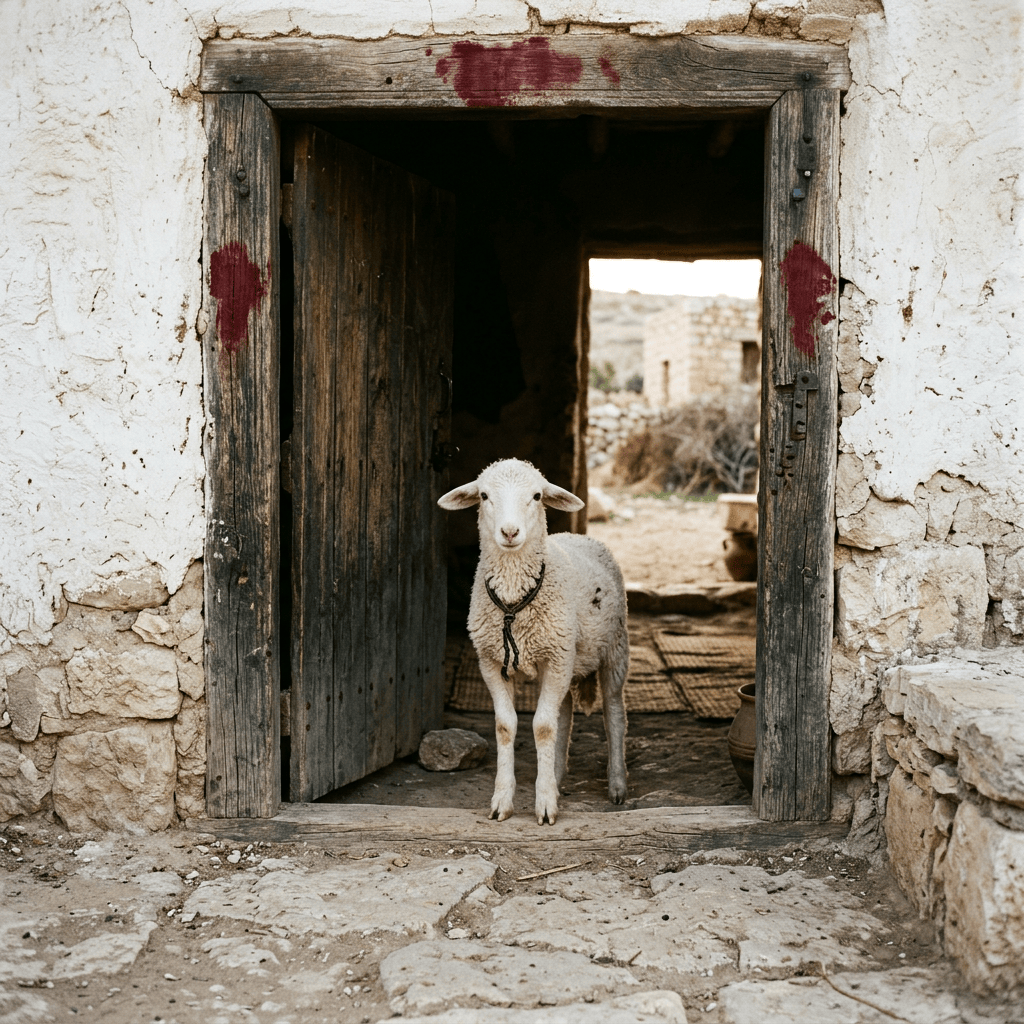
Story three: The 10th plague in Egypt
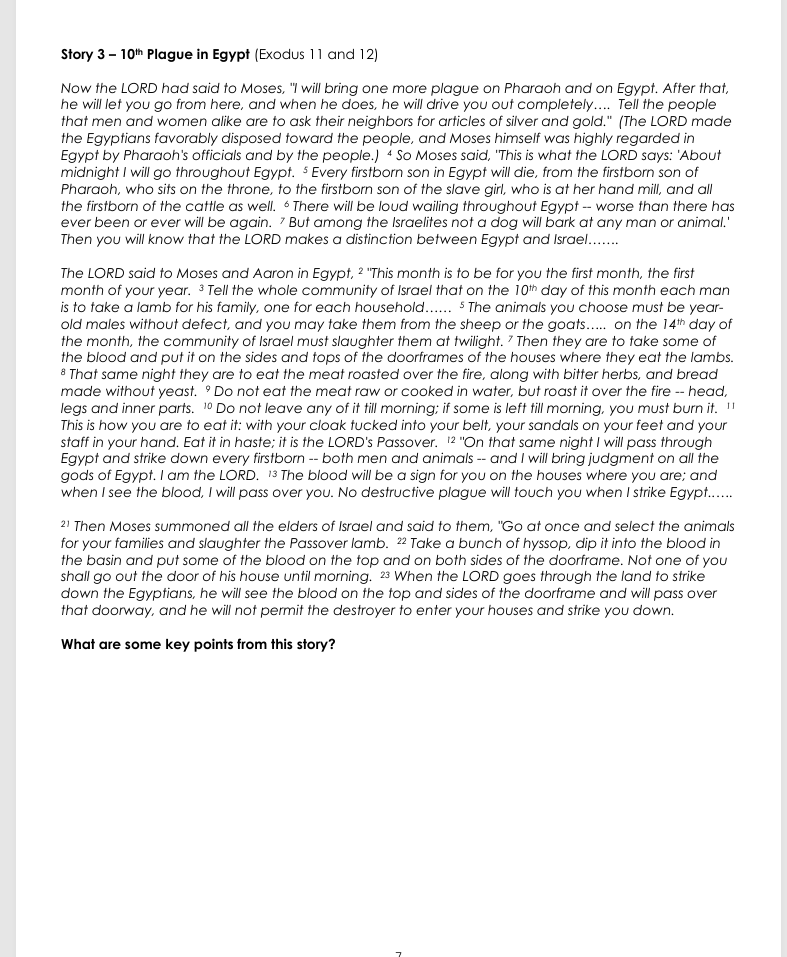
(Exodus 11 and 12) Now the LORD had said to Moses, “I will bring one more plague on Pharaoh and on Egypt. After that, he will let you go from here, and when he does, he will drive you out completely…. Tell the people that men and women alike are to ask their neighbors for articles of silver and gold.” (The LORD made the Egyptians favorably disposed toward the people, and Moses himself was highly regarded in Egypt by Pharaoh’s officials and by the people.) 4 So Moses said, “This is what the LORD says: ‘About midnight I will go throughout Egypt. 5 Every firstborn son in Egypt will die, from the firstborn son of Pharaoh, who sits on the throne, to the firstborn son of the slave girl, who is at her hand mill, and all the firstborn of the cattle as well. 6 There will be loud wailing throughout Egypt — worse than there has ever been or ever will be again. 7 But among the Israelites not a dog will bark at any man or animal.’ Then you will know that the LORD makes a distinction between Egypt and Israel……. The LORD said to Moses and Aaron in Egypt, 2 “This month is to be for you the first month, the first month of your year. 3 Tell the whole community of Israel that on the 10th day of this month each man is to take a lamb for his family, one for each household…… 5 The animals you choose must be year old males without defect, and you may take them from the sheep or the goats….. on the 14th day of the month, the community of Israel must slaughter them at twilight. 7 Then they are to take some of the blood and put it on the sides and tops of the doorframes of the houses where they eat the lambs. 8That same night they are to eat the meat roasted over the fire, along with bitter herbs, and bread made without yeast. 9 Do not eat the meat raw or cooked in water, but roast it over the fire — head, legs and inner parts. 10 Do not leave any of it till morning; if some is left till morning, you must burn it. 11 This is how you are to eat it: with your cloak tucked into your belt, your sandals on your feet and your staff in your hand. Eat it in haste; it is the LORD’s Passover. 12 “On that same night I will pass through Egypt and strike down every firstborn — both men and animals — and I will bring judgment on all the gods of Egypt. I am the LORD. 13 The blood will be a sign for you on the houses where you are; and when I see the blood, I will pass over you. No destructive plague will touch you when I strike Egypt..…. 21 Then Moses summoned all the elders of Israel and said to them, “Go at once and select the animals for your families and slaughter the Passover lamb. 22 Take a bunch of hyssop, dip it into the blood in the basin and put some of the blood on the top and on both sides of the doorframe. Not one of you shall go out the door of his house until morning. 23 When the LORD goes through the land to strike down the Egyptians, he will see the blood on the top and sides of the doorframe and will pass over that doorway, and he will not permit the destroyer to enter your houses and strike you down.
Now this is a very common story. Most people have heard of the ten plagues and one of my favorite movies is “The prince of Egypt”. A great movie with a great soundtrack. The story goes that Moses was sent to free the Israelites from their bondage in Egypt. Pharaoh doesn’t want to let them go and so God sent ten plagues until finally pharaoh relents. (This is a great story we’ll come back to eventually). The last plague was the death of the first born and this wasn’t just children but it was also adults…. I’m the first born of my mother so that would put me on the chopping block. A true lamb chop…. Sorry. Anyway the main point of this lesson is substitute sacrifice and in this story it’s much clearer to see that a lamb dies in place of the death in the household.
So let’s review:
In Story one- We have a random animal sacrificed- covering
In Story two- a ram- substitutes/individual
In story three- A lamb- Substitutes/group
It was at this point after all three stories that I realized before Sinai and the sanctuary and such we had sacrifices. Which seemed funny because it’s only after the blueprint that sacrifices get categorized and different sacrifices have meaning and we learn more of what that meaning is. But before Sinai it was unknown how much they truly understood of what those sacrifices meant, the symbolism, the later plan of salvation.
(Hebrews 10:8-10) Previously saying, “Sacrifice and offering, burnt offerings, and offerings for sin You did not desire, nor had pleasure in them” (which are offered according to the law), then He said, “Behold, I have come to do Your will, O God.” He takes away the first that He may establish the second. By that will we have been sanctified through the offering of the body of Jesus Christ once for all.
*It’s important to note that Seventh-day adventist believe Ellen G. White and that her writings are true and she notes that Adam was privy to the plan of salvation and taught his children. But what that knowledge meant and what it encompassed is unknown. And for the sake of this study I’m trying to stick as much as possible with the bible.
The point is they were doing sacrifices from the beginning. And we see that in plenty of examples such as Cain and Abel, Noah, Abraham. They even built altars. But it is a wonder what they thought it meant. Because in those examples they were primary blood sacrifices but they were for all sorts of reasons. Like thanks, worship, covenant and dedication.
Before Sinai sacrifices were more than just a sin payment, it was a language of relationship between God and his people. It was the beginning of the language of the covenant. And so by the time we get to Exodus the people already had built a habit passed down from generation to generation building a culture and language of sacrifice.
They just needed to learn what it means, what each sacrifice reveals, and where it is ultimately pointing.
In teaching we call this scaffolding. If we want to teach something it much easier to break it down into steps and teach one step at a time then trying to teach it all at once and hoping the learner gets it.
The sanctuary shows us the blueprint of salvation. But before that he teaches them the habit they will need to fulfill it.
How could they truly understand the sacrifice that was needed? The reason for the ransom? The reason for death? The reason that God, who loved humanity so much, had to save the world in the strangest way?
This is the most complex lesson that humanity would ever learn. So block by block he taught them to walk before they could run.
- Sin separated us from God.
- Death is the consequence of sin.
- God introduces substitution.
- That substitution points to something beyond itself.
- God promised a deliverer to redeem us.
Pre-Sinai they didn’t have the blueprint, or understanding of different sacrifices and the substitutes and why each was important for what but they built a habit.
Genesis gave us the shape
Exodus/leviticus gave us the system
And Jesus would give us the fulfillment.
(Psalm 91:14-16) “Because he has set his love upon Me, therefore I will deliver him;
I will set him on high, because he has known My name. He shall call upon Me, and I will answer him; I will be with him in trouble; I will deliver him and honor him. With long life I will satisfy him, And show him My salvation.”


Leave a comment